First to benefit were the larger landowners. Two farmers in Doña Ettelvina's village saw their incomes rise quickly from $1,000 to $1,500 a year. But poorer farmers also felt the benefit. New jobs opened up in planting, cutting and loading the cane and average cash wages tripled to 900 a year. Consumer goods - from radios and pick-up trucks to neon-lit bars - appeared as if from nowhere.
But there was a price to be paid. As more and more men took jobs in the sugar industry and more and more smallholdings were planted with cane, local food production steadily declined. In one year alone, consumption of local maize and rice declined 15 per cent and wheat imports rose 62 per cent. Soon there was a national shortage of staple foods. 'In the old days,' says Doña Ettelvina, 'we were poor but there was plenty of food. Now, we have money but nothing to eat.'
As sugar-cane crept over fallow lands and as men had less and less time to 'slash and burn' new fields out of the jungle, crop yields began to fall. A field which used to he fallow for 12 years to replenish its soil and which yielded 2,500 lbs of maize per acre, is now left fallow for only three years and yields only 900 lb per acre.
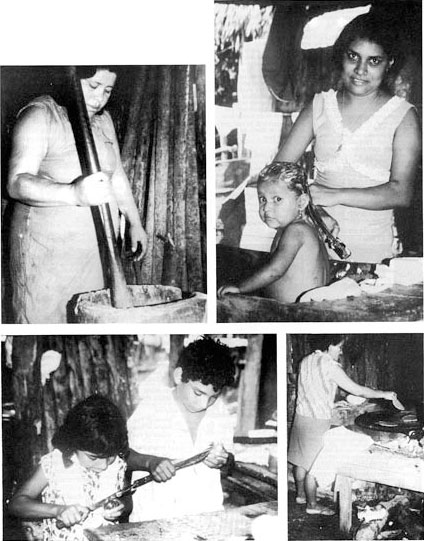
It is the women who have paid the heaviest price. The food crop used to be brought into the home and jointly owned by the family. Its preparation, storage and distribution was the responsibility of the woman and formed the basis of her social and economic role. Part of the crop she stored to be eaten in the months before the next harvest. Another part she sent to needy female relatives as insurance against the time when the harvest failed and she herself would need similar help.
The part of the crop which was spoilt by mould or parasite, she fed to pigs, turkeys, chickens and pigeons. And these animals provided not only food for the family but also economic power for the women who owned and tended them. A pig could reach 150 lb in weight within a year and be sold for about $48. So if a child fell ill or needed books or a new pair of shoes, the animals were like a piggy-bank on the hoof.
Some women kept four pigs at a time - adding substantially to their income, providing meat for feast-times and for Sunday dinner. 'Poor indeed was the household that could not afford meat,' says Doña Ettelvina.
As sugar-cane took over, less and less food was brought into the home and the woman's economic and social position was gradually eroded. There was no longer enough food to give to animals and in one year alone the number of pigs in Doña Ettelvina's village fell from 250 to less than 100. And with them has gone much of the women's food, money, and prestige. Meat consumption has fallen, even though canned meat is now imported.
The loss of food crops and animals has now left women like Doña Ettelvina almost entirely dependent on men. She no longer has her own earning power and can no longer send support to female relatives or expect it in return. The sugar cash, which has replaced food, belongs to the men.
Yet the men's incomes have not risen enough to pull families out of poverty. And although the illusion of prosperity is widespread, persistently high child malnutrition shows that it is only an illusion. And Doña"a Ettelvina has the difficult choices to make. The male wage-earners have to be kept healthy and happy. And when it comes to the distribution of food, it is often a case of women and children last.
In the eyes of the economists in the city, development has come to this corner of Belize. Income per capita has undoubtedly risen. But who has benefitted? The large landowners certainly. Some of the men maybe. But Doa Ettelvina not at all. |